
Bridge
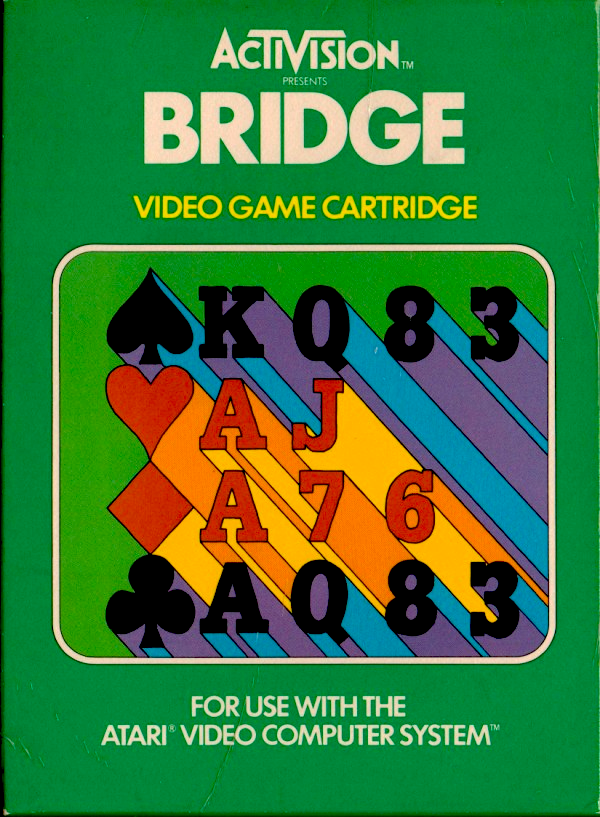
Bridge is a card game released for the Atari 2600 that brings one of the most traditional and complex card game variants to home consoles: Contract Bridge. Unlike the action-focused games that dominated the Atari library, Bridge offered a more cerebral and strategic experience, aimed at players who appreciate logical reasoning, memory, and careful planning.
Released in the early 1980s, the game was developed to appeal to an adult audience, which was relatively uncommon at the time, since most Atari 2600 titles were centered on fast-paced or arcade-style action. Bridge stands out as one of the few games on the console that faithfully simulates a classic card game, respecting its rules and overall structure.
Gameplay
In Bridge, the player takes part in matches that follow the traditional rules of Contract Bridge, playing alongside a virtual partner against two opponents controlled by artificial intelligence. The game includes:
Full dealing of the cards
A bidding phase, where players define the contract
A trick-taking phase, in which players attempt to fulfill or defeat the established contract
Despite the limitations of the Atari 2600 hardware, the game manages to functionally represent all the essential stages of Bridge. The player uses the controller to select cards, make bids, and take strategic decisions throughout the match.
Artificial Intelligence
One of the most impressive aspects of Bridge on the Atari 2600 is its artificial intelligence. For its time, the computer-controlled opponents and partner display reasonably consistent behavior, making logical bids and coherent plays based on the cards in hand.
While it does not replace a real match between experienced players, the AI provides a solid challenge and helps both beginners and more advanced players practice the game.
Graphics and Sound
Visually, Bridge is simple and functional, as expected from a card game on the Atari 2600. The cards are clearly represented, with easily recognizable symbols, prioritizing readability over visual effects.
The game does not feature continuous background music, relying instead on basic sound effects to indicate actions such as card selection or move confirmation. This choice helps keep the focus on strategy, without unnecessary distractions.
Difficulty and Accessibility
Bridge is a game that requires prior knowledge of the rules. It is not an easy title for complete beginners, as the Atari 2600 does not provide detailed tutorials. Players already familiar with Bridge will feel more comfortable, while newcomers will need patience and some external reading to fully enjoy the experience.
On the other hand, the game works very well as an individual training tool, allowing players to practice strategies, memorize plays, and develop game-reading skills without the pressure of a real table.
Historical Importance
Bridge holds a curious and important place in the Atari 2600 library. It represents a clear attempt to expand the video game audience beyond arcade-style entertainment, exploring traditional tabletop and card games.
It is a title that showcases the versatility of the console and the creativity of developers at the time, who managed to adapt a complex game like Bridge to extremely limited hardware.
Legacy
Today, Bridge is remembered as a niche title, but one that is highly respected by Atari 2600 collectors and enthusiasts. It proves that the console was not limited to action and fast reflexes alone, but also offered calmer and more intellectual experiences.
For fans of card games, video game history, or Atari 2600 curiosities, Bridge is an interesting, distinctive title that represents an experimental phase of the industry.
Larry Kaplan
1980


Playing: Bridge
Copyright Notice: This game is provided exclusively for educational, historical, and cultural preservation purposes. All rights belong to their respective owners and copyright holders.
Atari Classics acts as a historical preservation platform and is open to immediate removal of this content upon request from rights holders. For more information, please see our Copyright Policy.


Comments 0
Leave your comment