
Superman
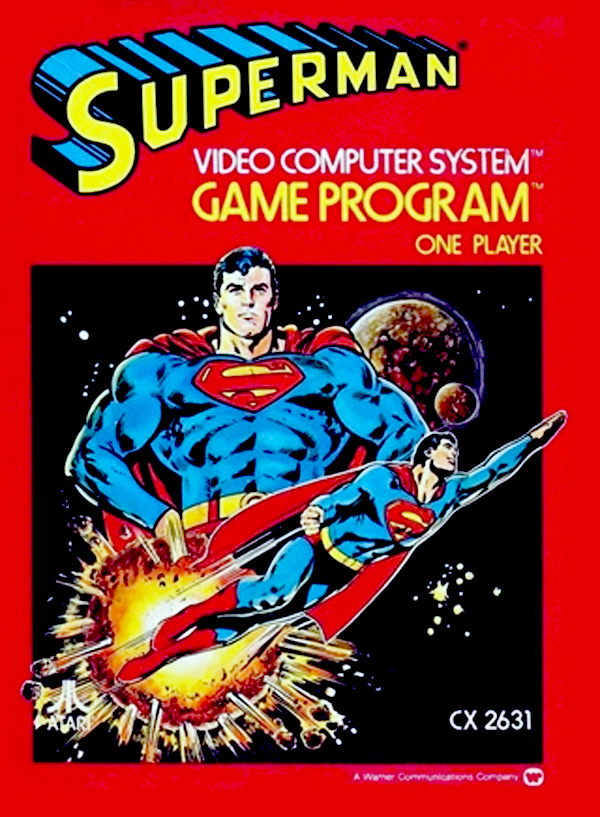
The Superman game for the Atari 2600, released by Atari in 1979, is a true milestone in video game history. Developed by John Dunn, it is widely considered one of the most important and innovative titles of its generation, breaking several paradigms for the era.
The Review: What was the game like? Unlike the vast majority of Atari cartridges based on arcade games (which focused solely on endless scoring on a single static screen), Superman introduced a non-linear open-world structure, featuring multiple interconnected scenarios, missions, and a basic inventory.
The Setting: The map was divided into various screens — including the city of Metropolis, the Daily Planet, Lex Luthor's lair, and a destroyed bridge.
The Mission: Lex Luthor and his henchmen scatter pieces of a broken bridge across the city and capture Lois Lane. Superman's objective is to capture the villains and put them in jail, find and collect the pieces of the bridge to rebuild it, rescue Lois Lane and return to Metropolis. Finally, find the infamous Kryptonite to weaken its effect (removing it from the path), fly to the telephone booth, change clothes, and return as Clark Kent to win the game.
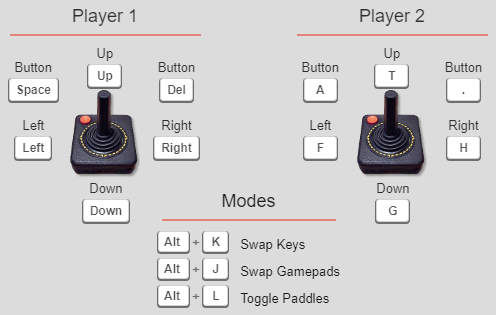
Controls and Gameplay: The 1-button joystick was used to fly in 360 degrees, walk on foot as Clark Kent, and fire the "heat ray" or use X-ray vision. The game even featured a two-player mode (co-op or competitive).
Fascinating Trivia
The first superhero-based game: Superman was an absolute pioneer. It was the first electronic game to officially adapt a character from DC Comics.
The first official "Easter Egg" (sort of): Although Adventure creator Warren Robinett popularized hidden Easter eggs, John Dunn placed his own name (CREATED BY JOHN DUNN) secretly printed on the screen within the game, something extremely rare in the early days of Atari programming.
Innovative scrolling and transitions: The screen changed instantly when Superman flew to the edges, simulating a vast map, something incredibly complex for the extremely limited Atari 2600 hardware (which had only 128 bytes of RAM).
Sacrificing visuals for mechanics: To fit so many screens, interconnected items, and simultaneous flight, the graphics were simplified — Superman looked more like a rudimentary geometric block figure, but the fun and complexity made up for the simple visuals.
John Dunn
1979


Playing: Superman
Copyright Notice: This game is provided exclusively for educational, historical, and cultural preservation purposes. All rights belong to their respective owners and copyright holders.
Atari Classics acts as a historical preservation platform and is open to immediate removal of this content upon request from rights holders. For more information, please see our Copyright Policy.






Comments 0
Leave your comment